Google Ads AI Max in 2026: What Advertisers Need to Know
- By Admin
- 1 October 2026
Google Search advertising is moving beyond the traditional model of choosing keywords, writing ads, setting bids, and manually refining every search term. In 2026, AI Max Google Ads is changing how Search campaigns find queries, adapt ad messaging, and connect users with relevant landing pages.
This does not mean advertisers can simply switch on AI and stop managing campaigns. The real opportunity is using automation with strong business inputs, accurate conversion tracking, relevant landing pages, and clear campaign goals.
For businesses already investing in Google Ads services, understanding this shift is becoming important for controlling spend while finding additional high-intent opportunities.
What Is AI Max for Google Ads?
AI Max is not a separate campaign type. Google describes it as an optimization layer for existing Search campaigns that combines AI-powered search term matching with creative and landing-page enhancements.
Its core capabilities include:
 Expanded search term matching
- AI-assisted text customization
- Final URL expansion
- More detailed performance insights
- Additional brand and location controls
The objective is to help a Google Ads campaign respond to the way people actually search, including queries that may not exactly match the keywords an advertiser originally selected.
Google reported that AI Max campaigns using its full feature set saw an average 7% increase in conversions or conversion value at a similar CPA or ROAS compared with search-term matching alone. This is Google's internal 2026 data, so advertisers should treat it as a benchmark rather than a guaranteed result.
What Changed in Google Ads AI Max in 2026?
The biggest change is the movement from optional experimentation toward broader adoption.
Google announced that eligible Search campaigns using automatically created assets, now called text customization, and campaign-level broad match are being automatically upgraded to AI Max from September 2026. The transition for Dynamic Search Ads, however, has been extended to February 2027.
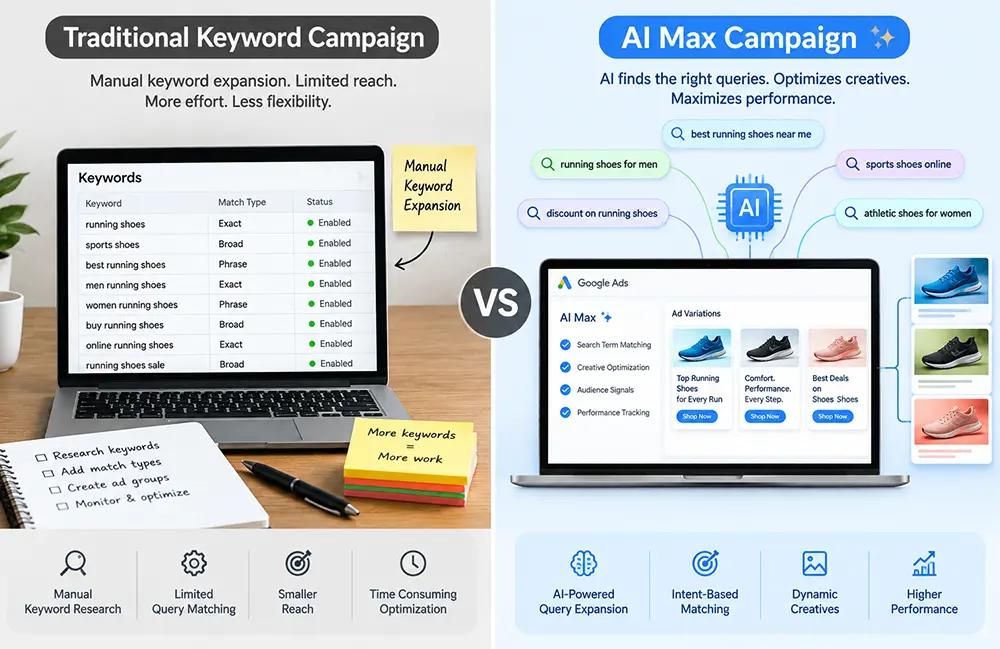
This matters because the traditional keyword-first approach is becoming less rigid.
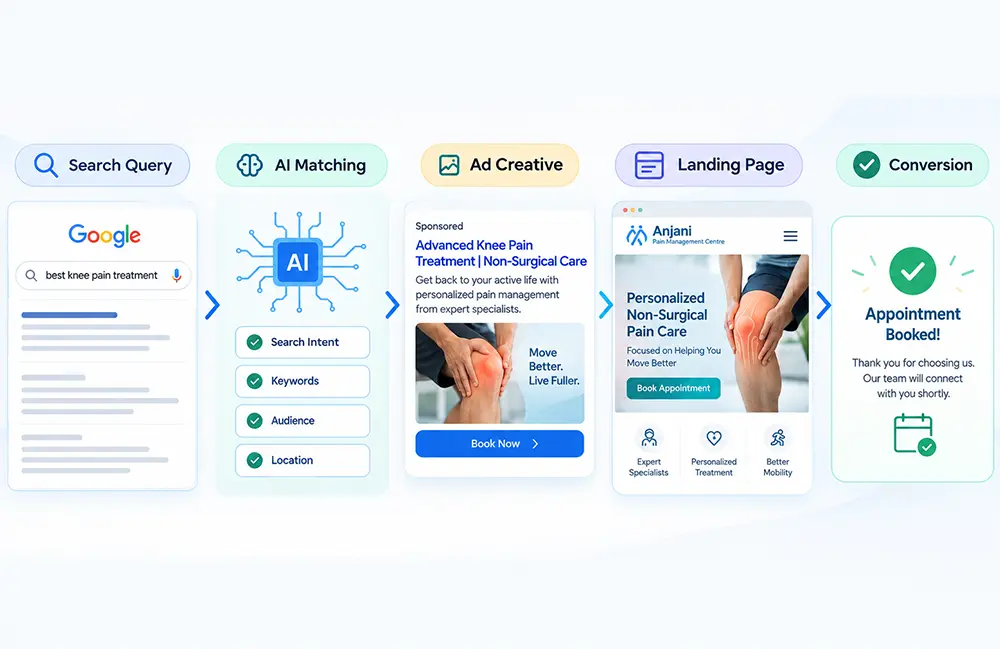
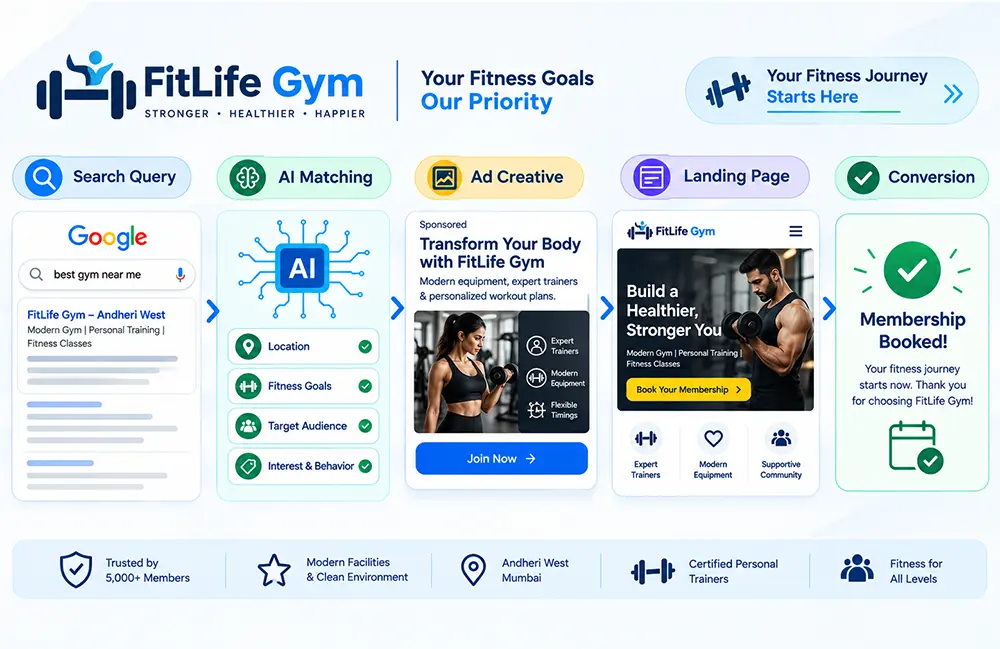
Instead of relying only on manually selected keyword variations, AI can use signals from keywords, ads, landing pages, and real-time search behavior to identify relevant opportunities. That makes Google Ads targeting more intent-driven, but it also makes campaign structure and landing-page quality more important.
Google has also introduced additional AI Max testing and reporting tools in 2026. Recent updates include unified reporting designed to show the search term, creative asset, and landing page involved in the customer journey.
How AI Max Changes Google Ads Optimization
With traditional campaigns, advertisers often spend significant time reviewing search terms, adjusting keywords, testing ad variations, and deciding which landing page should receive traffic.
AI Max automates more of this process.
For example, a user might search for a highly specific service phrase that is not identical to the advertiser's keyword. AI-powered matching can identify the underlying intent and potentially connect the search with an appropriate ad and landing page.
However, automation does not remove the need for human judgment.
Effective Google Ads optimization still starts with:
- Accurate conversion tracking
- Clear campaign objectives
- Strong keyword and audience research
- Relevant landing pages
- Appropriate geographic targeting
- Negative keyword management
- Regular performance analysis
AI can process signals at scale, but it does not know your business priorities unless you provide the right inputs.
AI Max Does Not Mean “Set It and Forget It”
This is where many advertisers can make a costly mistake.
Google Ads automation can expand reach, generate creative variations, and adjust targeting based on signals, but advertisers still need to evaluate whether those additional clicks have commercial value.
A campaign generating more conversions is not automatically better if lead quality falls, average order value decreases, or acquisition costs become unsustainable.
For lead-generation businesses, compare metrics such as:
 Cost per qualified lead
- Conversion rate
- Lead-to-customer rate
- Cost per acquisition
- Search-term quality
- Revenue generated
For eCommerce campaigns, revenue, ROAS, average order value, and product-level profitability provide more useful context than clicks alone.
That is why experienced PPC management combines automation with continuous testing and business-level analysis.
Your Landing Page Still Matters
AI can improve the path between a search query and an advertisement, but the visitor still needs a useful destination.
If the landing page is slow, confusing, outdated, poorly structured, or unrelated to the ad message, additional traffic will not solve the conversion problem.
This is also where paid advertising connects with wider website strategy. A technically sound website supports both advertising and organic visibility.
Businesses can strengthen this foundation through website development services and reliable web hosting and server solutions, particularly when page speed, uptime, security, and scalability are important.
For businesses planning new landing pages, the practical cost considerations discussed in Website Design Cost in 2026 can also help align design decisions with campaign requirements.
What 2025-2026 Google Search Updates Mean for Advertisers
Google's major Search updates are primarily about organic Search, so they should not be confused with Google Ads algorithm changes.
The December 2025 core update ran from December 11 to December 29, 2025. In 2026, Google also completed March and May core updates, along with spam updates in March, June, and August.
For businesses running paid campaigns, the practical lesson is broader: do not treat the landing page as an afterthought.
Google continues to emphasize useful, people-first content and its spam policies address practices such as scaled content abuse, keyword stuffing, and manipulative techniques. Google's documentation also makes clear that AI-generated content itself is not automatically prohibited; the concern is content created at scale primarily to manipulate Search rankings without providing real value.
That principle is useful for PPC as well. A landing page should answer the user's question, demonstrate the business's credibility, explain the offer clearly, and make the next step easy.
How to Prepare Your Google Ads Campaign for AI Max
Before enabling or expanding AI-powered features, review the fundamentals.
- First, audit conversion tracking. AI systems need reliable conversion signals. If forms, calls, purchases, or qualified leads are not being tracked correctly, automation can optimize toward the wrong outcome.
- Second, improve landing-page relevance. The page should closely reflect the advertisement and search intent.
- Third, review Google Ads targeting. Define appropriate locations, audiences, brand controls, exclusions, and campaign objectives rather than allowing expansion without guardrails.
- Fourth, use experiments where appropriate. Google provides AI Max experiments so advertisers can test the impact of AI features before applying them broadly.
- Finally, evaluate business outcomes, not just platform metrics. CTR and CPC are useful diagnostics, but qualified leads, sales, revenue, and profitability determine whether a campaign is actually working.
AI Max and the Bigger Digital Marketing Strategy
AI Max works best when paid search is not operating in isolation.
Search data can reveal what customers want, which questions they ask, and which services generate commercial intent. Those insights can inform organic content, landing pages, and broader digital marketing services.
For organic growth, SEO in Digital Marketing: Drive Long-Term Growth explains how SEO can build sustainable visibility alongside paid campaigns.
Businesses can also compare paid and organic approaches through PPC Advertising in Digital Marketing: Quick Results, which covers campaign structure, landing pages, negative keywords, measurement, and PPC-SEO integration.
The key is not choosing automation over human strategy. It is using automation where it improves scale while keeping strategic control over the parts that directly affect business performance.
Final Takeaway
AI Max Google Ads represents a significant shift in how Search campaigns operate in 2026. Google's direction is clear: more AI-assisted matching, creative optimization, automation, experimentation, and reporting.
But better technology does not replace better strategy.
Advertisers who combine reliable conversion data, strong landing pages, sensible Google Ads targeting, thoughtful Google Ads automation, and continuous Google Ads optimization will be in a stronger position to evaluate whether AI Max is actually creating incremental business value.
The goal should never be more automated traffic simply for the sake of scale. The goal is to turn relevant search intent into measurable business results.
LSI & long-tail keywords: AI Max for Search campaigns, AI-powered Google Ads, AI Max campaign optimization, Google Search advertising 2026, AI-powered PPC campaigns, automated Google Ads targeting, Google Ads AI automation, Search campaign optimization, Google Ads conversion optimization, AI Max landing page optimization, Google Ads bidding automation, PPC campaign management, AI-powered search advertising, Google Ads lead generation, Google Ads performance optimization.